

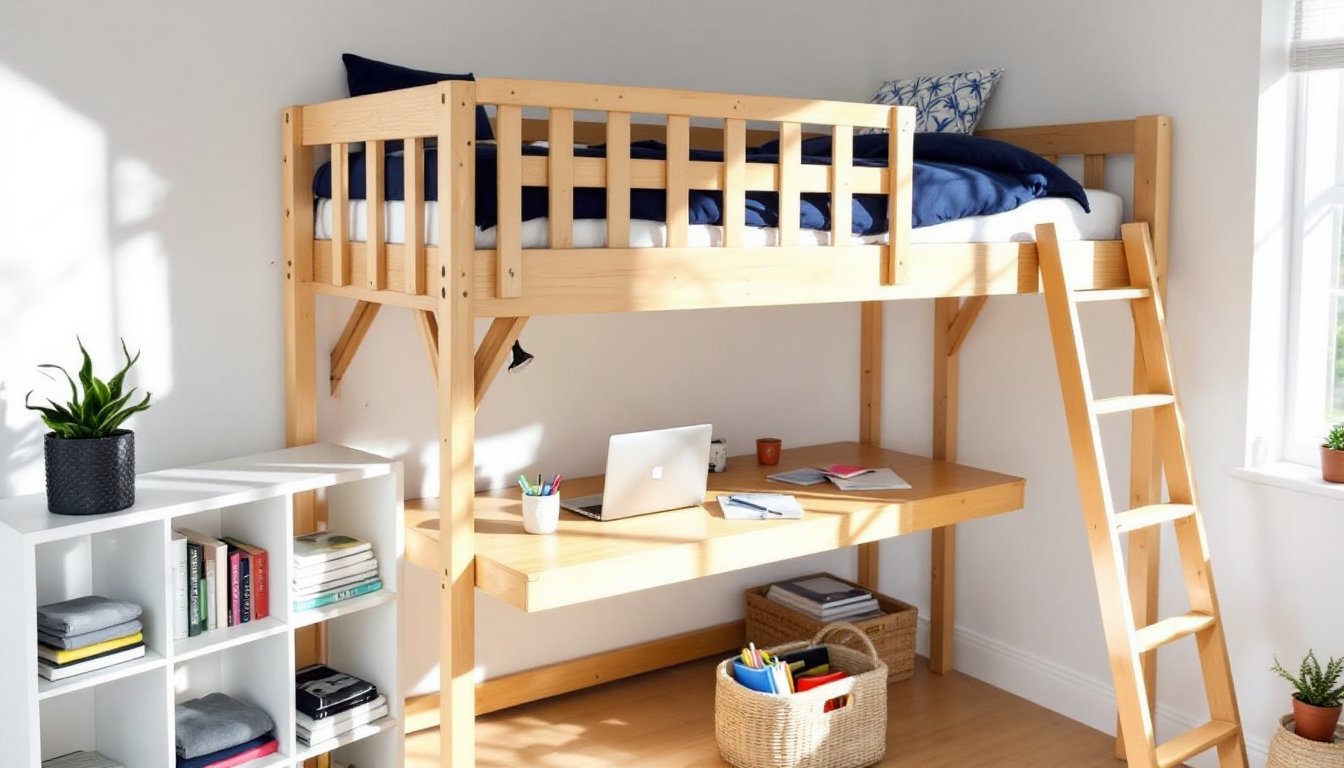

Small bedrooms demand smart furniture choices. Whether it’s a child’s room, a teen’s study space, or a compact guest bedroom, square footage dictates function. A twin bed with integrated desk and storage eliminates the need for three separate pieces of furniture, freeing up floor space while maintaining everything needed for sleep, work, and organization. These multi-functional units aren’t just for kids, college students, apartment dwellers, and anyone working with limited space can benefit from combining sleep, work, and storage into one footprint. Done right, they create functional zones without sacrificing comfort or usability.
Key Takeaways
- A twin bed with desk and storage reduces floor space usage by 40-60% compared to separate furniture pieces, making it ideal for small bedrooms, apartments, and multi-purpose rooms.
- Loft beds with desk and storage underneath require at least 8-foot ceilings and work best for children over 6 years old and adults comfortable with climbing, while captain’s beds sit at standard height and suit all ages with accessible drawer storage.
- Accurate room measurements including ceiling height, door swing, and window placement are essential before choosing a twin bed with desk and storage setup to ensure proper fit and functionality.
- DIY loft bed projects require intermediate carpentry skills, quality dimensional lumber (2x4s and 2x6s), wall-stud anchoring for safety, and cost approximately $200-400 in materials, with critical periodic fastener checks to prevent structural failure.
- Maximize a twin bed with desk and storage through organization strategies like using labeled bins, drawer dividers, wall-mounted shelves, and cable management systems, plus quarterly purges to prevent clutter accumulation.
Why Choose a Twin Bed with Desk and Storage?
The math is simple: a standard twin bed occupies about 39 inches by 75 inches. Add a desk (48 inches wide minimum) and a dresser (36 inches), and you’ve consumed roughly 120 linear inches of wall space, assuming perfect placement. Combine all three functions, and that footprint shrinks by 40-60%, depending on the design.
Beyond space savings, integrated units create defined zones in small rooms. The desk area becomes a dedicated workspace, separated visually from the sleep zone even when they share the same structure. Storage built into the bed frame keeps clothing, books, and supplies within arm’s reach without requiring additional furniture.
These setups work particularly well in rooms where a traditional bedroom layout won’t fit, converted attics with sloped ceilings, basement bedrooms with low clearances, or multi-purpose spaces that serve as both bedroom and office. They’re also easier to move than separate furniture pieces, a real advantage for renters or families who relocate frequently.
The key benefit isn’t just saving space, it’s making small spaces work harder without feeling cramped or cluttered. When done well, these beds don’t look like compromise furniture. They look intentional.
Types of Twin Beds with Integrated Desks and Storage
Not all combo beds are created equal. Understanding the two main configurations helps match the right design to the room’s dimensions and the user’s needs.
Loft Beds with Desk and Storage Underneath
Loft beds elevate the mattress 4-6 feet off the floor, creating a full workspace underneath. The area below typically accommodates a desk, shelving, and sometimes a small dresser or bookcase. Ceiling height is the limiting factor, most loft beds require at least 8-foot ceilings to allow comfortable sitting on the mattress without bumping your head. Measure carefully: the mattress surface should sit at least 36-40 inches below the ceiling.
Safety matters here. Look for guardrails that extend at least 5 inches above the mattress surface on all open sides. Ladder design varies, some attach vertically, others angle out for easier climbing. Angled ladders are easier on the knees but consume more floor space.
Loft beds work best for kids over 6 years old (younger children shouldn’t sleep elevated) and anyone comfortable with climbing. They’re ideal when floor space is extremely tight, as the entire desk area lives under the bed. Downsides include difficulty changing sheets and the need to climb up and down multiple times a day. For those interested in building custom furniture like loft beds, woodworking project plans offer detailed blueprints and cut lists.
Weight capacity varies widely. Budget models max out around 200 pounds, while heavy-duty steel frames handle 400+ pounds. Check the specs, if an adult will use it, don’t cheap out on the frame.
Captain’s Beds with Built-In Drawers and Desk Combo
Captain’s beds sit at standard height (12-18 inches off the floor) with storage drawers built into the base. Some models attach a desk unit to one end or side, creating an L-shaped footprint. Others pair the bed with a separate but matching desk and storage tower, designed to fit together as a coordinated set.
These beds don’t require climbing, making them suitable for all ages. The storage is more accessible than loft bed cubbies, just pull out a drawer. Many feature 3-6 drawers under the mattress, each typically 24-30 inches deep, enough for folded clothing, bedding, or bulky items.
The desk component in these systems is usually a separate piece that butts against the bed or sits perpendicular to it. This creates more flexibility in room layout but also means the footprint isn’t as compact as a loft bed. You’re saving furniture pieces, but not necessarily floor space.
Captain’s beds work well in rooms with normal ceiling heights (under 8 feet) or where climbing isn’t practical. They’re easier to make or modify than loft beds, many DIYers appreciate beginner-friendly building guides that walk through drawer construction and frame assembly.
How to Choose the Right Twin Bed Setup for Your Space
Start with accurate measurements. Measure the room’s length, width, and ceiling height. Note door swing, window placement, closet doors, and heating vents, all affect furniture placement.
For loft beds, ceiling height is non-negotiable. Measure from floor to ceiling at the spot where the bed will sit. Older homes often have uneven floors or sloped ceilings. A 7.5-foot ceiling is the bare minimum: 8+ feet is comfortable. Account for mattress thickness too, an 8-inch mattress adds to the overall height.
Consider the user’s age and mobility. Kids under 6 shouldn’t use loft beds (falls are a real risk). Teens and adults need to honestly assess whether they’ll tolerate climbing a ladder multiple times a day, especially at night or when sick.
Evaluate storage needs. Count how many drawers or shelves are needed for clothing, school supplies, books, and electronics. Loft beds offer vertical storage (shelves, hanging rods) under the bed. Captain’s beds provide horizontal drawer storage. Match the storage type to what’s being stored, drawers for clothing, open shelves for books and display items.
Desk size matters. A laptop requires less surface area (24-30 inches wide) than a desktop computer with monitor (36-48 inches minimum). Art students or anyone doing hands-on work needs even more spread-out space. Measure existing desk equipment before committing to a combo unit with a small desk surface.
Check weight ratings for both the bed and desk. If the bed will hold an adult or the desk will support a heavy monitor and equipment, verify the manufacturer’s specs. Particleboard and thin metal frames won’t hold up to heavy use.
Finally, think about longevity. A 7-year-old will outgrow some designs by middle school. Choosing a more mature style or a modular system that separates later extends the furniture’s useful life.
DIY Options: Building Your Own Twin Bed with Desk and Storage
Building a custom bed-desk combo isn’t beginner-level work, but intermediate DIYers with basic carpentry skills can tackle it. The payoff is a unit sized exactly to the room and built to last.
Materials: Most DIY loft beds use 2x4s and 2x6s for the frame (remember, a 2×4 actually measures 1.5″ x 3.5″). Dimensional lumber is stronger and safer than trying to build a bed from plywood alone. Plan on spending $150-300 on lumber, depending on your region and current pricing. Add $50-100 for hardware, lag bolts, corner brackets, and wood screws. Use 3-inch deck screws or lag bolts at all joints: drywall screws aren’t strong enough for furniture that supports body weight.
Tools needed: Circular saw or miter saw, drill/driver, level, square, tape measure, and clamps. A miter saw makes cleaner cuts on angled braces, but a circular saw with a speed square works. Wear safety glasses and hearing protection, cutting dimensional lumber is loud and throws sawdust.
Design considerations: For a loft bed, the frame must be secured to wall studs, not just drywall. Use a stud finder to locate studs, then attach the headboard or side rail with ½-inch lag bolts driven into the studs. Freestanding loft beds are unstable and dangerous.
Build the desk as a separate unit that fits underneath, or attach a desk surface to the loft frame using 2×2 cleats screwed into the bed’s support posts. The desk should be braced independently, don’t rely solely on the bed frame for desk support.
For captain’s beds, drawer construction is the tricky part. Simple open cubbies are easier than functional drawers with slides. If adding drawers, use bottom-mount drawer slides rated for 75-100 pounds. Measure the drawer box ½ inch narrower than the opening to allow slide hardware to fit.
Many DIY plans are available online, including detailed cut lists and hardware specs. Resources like free DIY furniture plans provide step-by-step instructions with diagrams, useful for anyone building their first bed frame.
Safety warning: If building a loft bed, double-check all fasteners after assembly and periodically (every 6 months). Wood can shift as it acclimates, and bolts can loosen. A bed failure is a serious injury risk. If you’re uncertain about structural integrity, consult a contractor or structural engineer before use.
Organization Tips for Maximizing Your Multi-Functional Bed
The bed is installed, now make it work.
Desk zone: Keep only active-use items on the desk surface. Everything else goes in drawers or shelves. Use a small organizer tray for pens, chargers, and daily supplies. Wall-mounted shelves above the desk (if it’s under a loft) keep books and decor off the work surface.
Under-bed storage (for loft beds): Use bins, baskets, or fabric drawers to corral items on open shelves. Label them. Without drawers, open shelving becomes a junk collector fast. Stick to a one-in, one-out rule, when something new goes in, something old comes out.
Drawer storage (for captain’s beds): Divide drawers with simple cardboard or plastic organizers to prevent clothing from becoming a jumbled mess. Roll t-shirts and pants instead of folding, they fit better and wrinkle less. Reserve the deepest drawers for bulky items like hoodies or extra bedding.
Vertical space: Install hooks on the side of a loft bed frame for backpacks, headphones, or robes. Pegboard mounted to the wall near the desk holds tools, art supplies, or charging cables.
Cable management: Run a power strip along the back edge of the desk and use cable clips or velcro straps to keep cords tidy. Loose cables are a tripping hazard on loft bed ladders.
Mattress access: For loft beds, use fitted sheets with deep pockets and consider sheet suspenders to keep corners in place. Changing sheets on an elevated bed is awkward, anything that makes it faster helps.
Finally, reassess every few months. Small spaces accumulate clutter quickly. A quarterly purge keeps the system functional and prevents the bed-desk combo from becoming overcrowded and unusable.